
Embodied AI is entering a new stage of development. Robotic foundation models are becoming more capable, improving their ability to understand instructions, reason about physical environments, and perform increasingly complex actions.
However, rapid advances in model development have also highlighted a major challenge for the industry: there is still no universally accepted way to measure embodied AI capabilities consistently.
A robot can produce an impressive result during a carefully designed demonstration, but that does not necessarily mean it will perform reliably in a different environment. Changes in lighting, camera noise, object properties, robot positioning, or instruction wording can all affect performance.
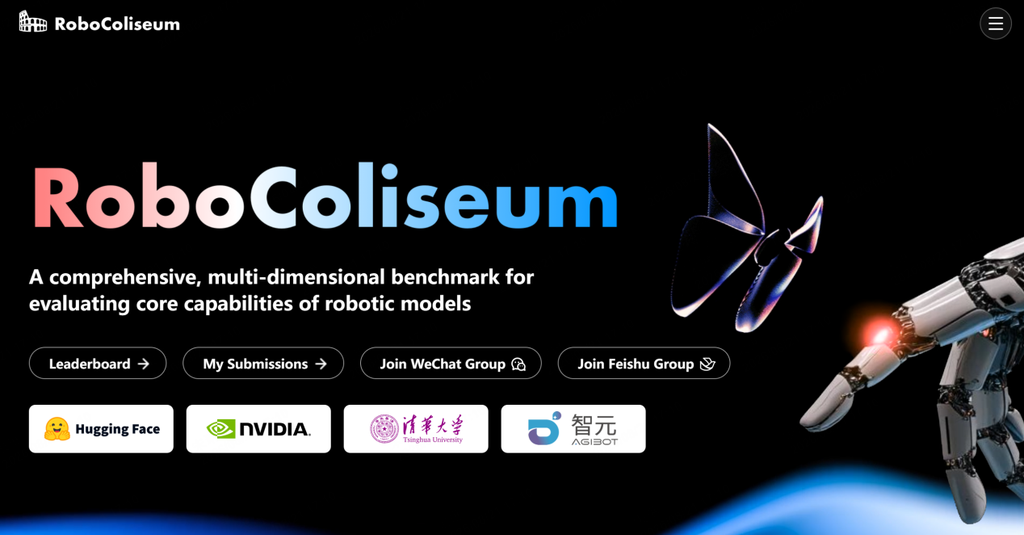
RoboColiseum has officially launched with the goal of addressing this challenge.
The platform is a standardized simulation evaluation environment built specifically for embodied intelligence. It provides developers with a structured way to test robotic models across multiple capabilities, compare results against established baselines, investigate failures, and improve model performance.
Universities, research institutions, AI companies, and individual researchers worldwide can participate in the platform. RoboColiseum is designed to support reproducible evaluation while continuously expanding its benchmarks according to the needs of the research and robotics communities.
Before its official launch, the platform’s closed beta attracted hundreds of teams from around the world to train and evaluate their models.
Learn more about RoboColiseum: http://robocoliseum.ai/
Table of Contents
Why Embodied AI Needs Better Evaluation
Measuring embodied intelligence is considerably more complicated than measuring performance on a conventional software benchmark.
A language or vision model can often be tested using a fixed dataset. Robots, however, interact with physical environments where conditions can change from one moment to the next.
A model might correctly complete a task under bright lighting but struggle in a darker environment. It could successfully manipulate one object but fail when the object’s material or position changes. Even a slightly different robot starting pose can alter the outcome.
These factors make it difficult to determine whether a model has developed genuinely transferable capabilities or has simply learned to perform well under specific conditions.
RoboColiseum aims to provide a more systematic approach.
By placing different models inside standardized simulation scenarios, the platform gives developers a common environment in which capabilities can be measured and compared.
High-Fidelity Simulation Designed to Reflect Reality
Simulation can significantly accelerate robotics development, but only when simulated results provide useful information about physical performance.
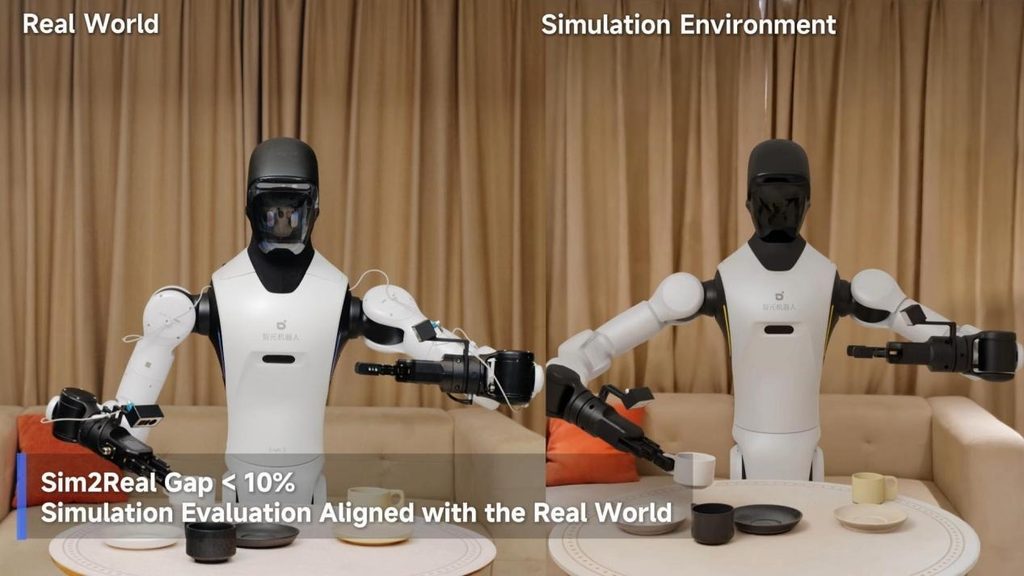
RoboColiseum uses a high-fidelity simulation environment that combines photorealistic rendering with physically accurate interactions.
The objective is to reproduce important aspects of real-world robotic environments while maintaining the scalability and convenience of simulation.
Real-world factors such as lighting, material properties, camera noise, object interactions, and robot positioning are incorporated into the evaluation design.
According to RoboColiseum, the platform’s sim-to-real gap is less than 10% within its evaluation framework.
If simulation results closely correspond to physical performance, developers can conduct more extensive testing before moving models to real robots.
That can potentially reduce hardware costs and shorten development timelines.
Connecting Simulation Training With Physical Validation
RoboColiseum is designed to support both simulation-trained and real-world-trained models.
Models trained using real robot data can be evaluated within the simulation environment. This allows developers to measure their capabilities under standardized conditions.
Meanwhile, systems trained in simulation can be transferred to physical robots for additional testing. Developers can then examine how successfully the model’s learned capabilities transfer from virtual environments to reality.
This two-way process provides a more complete view of robotic performance.
Instead of treating simulation and real-world testing as disconnected activities, developers can use both as parts of a continuous evaluation pipeline.
The process can be summarized as:
Train → Test → Diagnose → Improve → Deploy
Four Dimensions of Embodied Intelligence
RoboColiseum does not rely on one overall success rate to describe model performance.
Instead, the platform evaluates systems across four major capability dimensions:
Instruction Following
Measures how accurately a model understands natural-language commands and converts them into appropriate robotic actions.
Spatial Reasoning
Tests the model’s ability to understand object locations, relationships, and spatial arrangements.
Robustness
Examines whether the model can maintain performance when environmental or task conditions change.
Manipulation
Measures physical interaction skills and the ability to combine individual actions into longer sequences.
RoboColiseum currently offers four capability-specific leaderboards and 78 high-fidelity simulation evaluation tasks.
This gives developers a more detailed understanding of how their systems perform.
Measuring Natural-Language Instruction Following
For robots designed to work alongside people, understanding language is fundamental.
RoboColiseum evaluates models using instructions involving attributes such as color, shape, size, relationships, and logical requirements.
The evaluation considers whether the robot’s actions accurately match the requested objective.
This provides more information than simply checking whether the final task was completed.
A model could understand most of an instruction but overlook one important detail. Another could identify the correct object but fail to execute the required manipulation.
Separating instruction following into its own category helps developers locate these weaknesses.
Testing Spatial Reasoning Capabilities
Physical intelligence requires an understanding of space.
Robots need to know where objects are located, how they relate to one another, and how their own movements affect those relationships.
RoboColiseum tests spatial reasoning through tasks involving relative-position grasping, sorting, stacking, and other physical scenarios.
These evaluations combine semantic and geometric reasoning.
The model must not only recognize objects but also understand their positions and relationships before selecting an appropriate action.
Measuring Robustness Under Variable Conditions
A model’s true capabilities become clearer when familiar conditions are changed.
RoboColiseum introduces more than 10 types of real-world disturbances during evaluation.
These include variations in lighting, background, instruction phrasing, camera noise, gripper configuration, and other environmental factors.
The purpose is to test whether models can continue performing when conditions are no longer identical to those encountered during development.
Robustness testing is particularly important for systems intended for practical applications because real environments rarely remain perfectly consistent.
Evaluating Robotic Manipulation
Manipulation is one of the most important aspects of embodied intelligence.
Robots must be able to grasp objects, move them, position them accurately, and interact with multiple objects in an environment.
RoboColiseum evaluates a variety of atomic manipulation skills across different scenes.
The platform also introduces different difficulty levels, allowing researchers to examine how well models combine basic abilities into longer-horizon tasks.
This can reveal whether a model has difficulty with a particular physical action or struggles when several actions must be coordinated in sequence.
Going Beyond Final Success Rates
A final success score provides useful information, but it does not always explain the reason behind a failure.
RoboColiseum addresses this by dividing tasks into multiple subtasks.
The platform tracks the model’s progress through those subtasks and records where problems occur.
Developers can therefore examine which stages were completed successfully and which caused the final failure.
This can make evaluation much more useful for model improvement.
For example, a robot might correctly understand the command and locate the correct object but fail to grasp it. In that case, developers can focus on manipulation rather than changing the model’s language capabilities.
Using Diverse Data to Improve Benchmark Reliability
A benchmark should test general capabilities rather than familiarity with a fixed environment.
RoboColiseum uses large and diverse samples to reduce the impact of repeated layouts and predictable patterns.
Its evaluation methodology incorporates domain randomization, separated training and testing sets, and both in-distribution and out-of-distribution testing.
These techniques are designed to challenge models with conditions that are not always identical to those encountered during training.
The result is intended to be a more meaningful assessment of generalization.
Faster Model Evaluation
Building an evaluation environment independently can require substantial technical resources.
Researchers may need to configure simulation software, prepare assets, integrate models, manage computing infrastructure, and create custom evaluation procedures.
RoboColiseum provides an automated evaluation service intended to simplify these requirements.
According to the platform, developers can register and submit a model in approximately five minutes, deploy it with one click, and complete a simulation evaluation in around 30 minutes.
Following an evaluation, the platform provides detailed scores, task-level results, and videos showing model execution.
This allows developers to combine numerical performance data with visual inspection.
Local Inference With a Standardized Connection
Developers do not necessarily need to upload their model code and weights to RoboColiseum.
Instead, they can deploy an inference service locally and connect it to the platform through a standardized interface.
This approach allows research teams to maintain their existing model infrastructure while using RoboColiseum for standardized testing.
It can be particularly useful for teams that already have complex development environments or prefer to keep model assets within their own infrastructure.
AI Agents Support the Evaluation Workflow
RoboColiseum also incorporates AI Agent capabilities into its workflow.
Developers can use natural-language interaction to carry out tasks such as downloading data, training models, performing local validation, and submitting evaluations.
This approach is intended to reduce the amount of manual work involved in the model development and testing process.
As AI Agents become more integrated into technical workflows, natural-language controls could make robotics experimentation more accessible and efficient.
Benchmarking Against Recognized Models
Researchers need reference points when evaluating new systems.
RoboColiseum provides baseline results for several embodied foundation models, including ACoT-VLA, π0, π0.5, and GR00T.
Developers can compare their own model results with these established baselines across the platform’s four main evaluation dimensions.
This makes it easier to determine where a new model is competitive and where further development may be necessary.
Baseline comparisons also create a shared reference for researchers working on different approaches to embodied intelligence.
Supporting Reproducible Experiments
Reproducibility is essential for trustworthy AI research.
When different teams use different environments and evaluation procedures, reported results can be difficult to compare.
RoboColiseum supports reproducibility by providing training code and corresponding weights for baseline models used on platform tasks.
Researchers can reproduce baseline training, verify evaluation results, and conduct additional experiments under consistent conditions.
This shared framework can help researchers build on previous work while maintaining a clearer connection between different experimental results.
RoboColiseum as an Evaluation Arena
The name RoboColiseum reflects the idea of a common arena.
Different embodied AI models can enter the same evaluation environment and face standardized challenges.
However, the platform is not intended merely as a ranking system.
It also functions as a development ground where teams can repeatedly test models, discover weaknesses, make improvements, and measure the results.
This creates a continuous cycle of evaluation and development.
Encouraging a More Open Research Community
RoboColiseum welcomes participation from researchers and developers around the world.
Universities, research institutions, AI companies, and independent teams can use the platform to evaluate their systems.
The platform also encourages developers to open-source their models and contribute them to the broader embodied intelligence ecosystem.
Greater participation can increase the value of standardized benchmarking by providing more systems for comparison and creating opportunities for collaboration.
Moving From Demonstrations to Measurable Progress
The robotics industry has produced numerous impressive demonstrations.
But a single successful demonstration cannot fully answer whether a model is reliable.
A truly capable embodied AI system needs to perform across different tasks, understand diverse instructions, reason about physical environments, manipulate objects, and handle changes in its surroundings.
These abilities require systematic evaluation.
RoboColiseum is designed to provide that broader perspective.
Its multi-dimensional framework allows researchers to examine different components of robotic intelligence instead of reducing performance to a single number.
Making Evaluation Part of Model Development
Benchmarking can be most valuable when it is integrated throughout the development process.
A research team can train a model, evaluate it, identify where it fails, make targeted improvements, and run another evaluation.
Repeating this process creates a measurable development loop.
RoboColiseum aims to make this type of continuous evaluation easier by reducing the complexity associated with simulation setup and testing.
The platform can therefore function not only as a benchmark but also as a practical tool for iterative model development.
Aiming for More Reliable Embodied AI
As embodied AI continues to mature, reliable evaluation will become increasingly important.
Developers need to know whether their models can generalize beyond carefully controlled demonstrations. Researchers need comparable benchmarks. Organizations preparing robotic systems for real-world applications need confidence that performance will remain stable under changing conditions.
RoboColiseum aims to address these needs through a standardized evaluation environment.
Its combination of high-fidelity simulation, four capability dimensions, diverse tasks, robustness testing, task-level failure analysis, automated evaluation, and model baselines provides developers with a broader framework for understanding robotic performance.
The platform’s long-term vision is to create a standardized and continuously evolving evaluation system for embodied intelligence.
By bringing different models into a shared environment, RoboColiseum aims to make progress easier to measure, compare, reproduce, and improve.
The Next Stage of Embodied AI Evaluation
The launch of RoboColiseum arrives as embodied AI moves toward increasingly practical applications.
The industry’s next challenge is not simply building models that can succeed at individual tasks. It is developing systems that can perform reliably across environments, instructions, objects, and unexpected conditions.
Standardized evaluation can play an important role in achieving that goal.
RoboColiseum provides a platform where researchers can test capabilities, analyze failures, compare models, and continuously refine their systems.
Its vision extends beyond creating another leaderboard. The goal is to establish a shared environment where evaluation becomes an integral part of embodied AI research and development.
RoboColiseum is now officially open to developers and researchers worldwide.
Explore RoboColiseum: http://robocoliseum.ai/
