
A new collaboration between Ophilus and RhOS introduces Khora, a multiplayer world model that replaces traditional scaling limits with a shared-state architecture. The technology is already available through a public eight-player demo ophilus.ai/khora.
Artificial intelligence has become increasingly capable of generating realistic digital environments, but enabling dozens or even thousands of people to interact inside the same AI-created world has remained a major technical challenge. Ophilus believes it has found a solution with the introduction of Khora, a multiplayer world model engineered to keep every participant synchronized while supporting far greater scale.
Developed with RhOS, Khora moves beyond laboratory demonstrations by offering a playable public experience. Instead of watching a recorded showcase, users can step directly into an AI-generated multiplayer arena and experience the technology in action.
Table of Contents
A Hands-On Demonstration of Shared AI Worlds
Khora’s first public release is an eight-player first-person deathmatch designed to stress-test the system under real gameplay conditions.
Players navigate procedurally generated maps, battle opponents in real time, climb across changing terrain, and compete for the top position on a live leaderboard. The experience also includes elimination tracking and detailed post-match statistics.
Eight players compete in real time in Khora’s public demo at ophilus.ai/khora
While these features resemble those of conventional online games, the technology driving them is fundamentally different. Every participant explores the same AI-generated world, which must react instantly to player actions without breaking synchronization.
The live demo serves as a practical demonstration of Khora’s ability to maintain responsive gameplay and a consistent shared environment.
Why Scaling Multiplayer AI Is Difficult
Traditional world models focus on a single viewpoint.
The system predicts the next scene based on one player’s movement, generating what should appear as that person walks, turns, or interacts with the environment.
Introducing multiple players dramatically increases the complexity.
Every change made by one participant must immediately become part of a shared reality.
If someone opens a door, every other player should see that same door open. If two players cross paths, both perspectives must accurately reflect the interaction. Environmental changes, player positions, and object states all need to remain synchronized despite constant movement.
Keeping those experiences aligned while generating new frames in real time has become one of the biggest obstacles facing multiplayer world models.
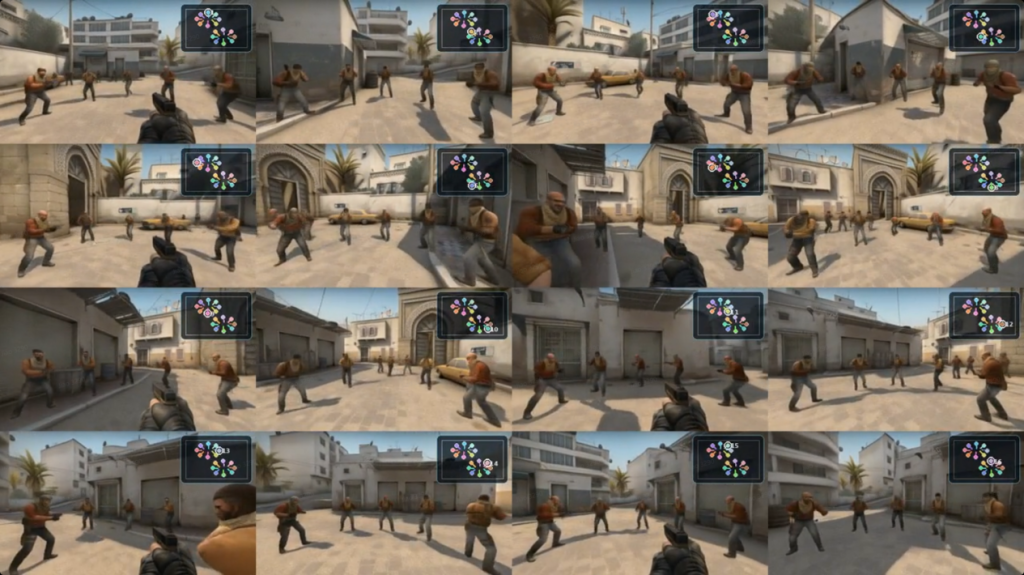
Sixteen generated player views, synchronized through the same evolving world state.
One World, Many Perspectives
Khora addresses this challenge through a unified world-state approach.
Rather than creating separate simulations for every participant, the model maintains one continuously evolving environment that serves as the foundation for every player’s experience.
Whenever someone performs an action, the shared state updates first. Individual viewpoints are then generated using that common information alongside each player’s local perspective.
This design allows every participant to experience the same world while preserving smooth and independent rendering for each viewpoint.
cross agent action consistency in Khora
Extending Earlier Multiplayer AI Research
Khora builds upon years of research into collaborative AI-generated environments.
Solaris demonstrated that two users could successfully interact within a jointly generated virtual world, while SolarisEngine introduced an open framework for gathering synchronized multiplayer gameplay data.
Other projects contributed different advances.
Agora-1 emphasized real-time world generation, whereas MIRA focused on producing richer and more visually detailed environments.
Although these systems demonstrated meaningful progress, they remained constrained by limited player counts or challenges related to scalability, synchronization, and long-term stability.
Khora was developed to move beyond those limitations.
STBoard Changes the Scaling Equation
One of the largest barriers to multiplayer AI lies in communication overhead.
Conventional systems often require every participant to exchange information directly with every other participant. As more players join, those communication pathways increase rapidly.
With more than one thousand participants, the number of required interactions exceeds one million.
Khora introduces a different solution called STBoard, or Spatio-Temporal Board.
Instead of relying on direct player-to-player communication, everyone connects to the same shared state.
Player actions update STBoard through a state transition process. Each participant then generates the next frame independently using the latest version of the shared environment.
This architecture allows computational demands to grow linearly as additional players join, rather than increasing quadratically.
According to Ophilus and RhOS, Khora is the first scalable multi-agent world model designed around this linear-time approach, making significantly larger multiplayer environments more practical.
Expanding the Platform
The current public demo represents only the first stage of Khora’s development.
Ophilus and RhOS have announced another major update planned for mid-August, which will introduce a broader selection of generated maps, visual themes, and gameplay styles.
The objective is to demonstrate stronger generalization by showing that the model can adapt to different environments without sacrificing synchronization or responsiveness.
Ophilus’ Broader Mission
Khora is part of Ophilus’ long-term strategy to advance AI-generated shared worlds.
Built on Yahaha’s multiplayer 3D platform, the company gathers synchronized multiplayer interactions to train future world models capable of understanding how complex virtual environments evolve through human activity.
Its vision is to develop AI systems that support increasingly large numbers of participants while preserving visual quality, real-time responsiveness, and consistent world behavior.
Looking Beyond Gaming
Although multiplayer games provide an ideal proving ground, the underlying technology has far wider potential.
Scalable world models could eventually power collaborative virtual offices, AI training environments, robotics simulations, immersive education, digital twins, interactive filmmaking, and shared virtual experiences where many users participate simultaneously inside AI-generated worlds.
As the technology matures, these applications may become just as important as entertainment.
Public Demo Now Available
Khora’s eight-player demonstration is now open to the public, allowing users to experience the multiplayer world model firsthand.
Ophilus and RhOS will continue sharing gameplay footage, technical progress, and future development updates as the platform evolves toward larger and more sophisticated shared AI environments.
This version adopts a more independent editorial voice with less promotional language, making it suitable for publication on technology news sites while remaining faithful to the original announcement.
