
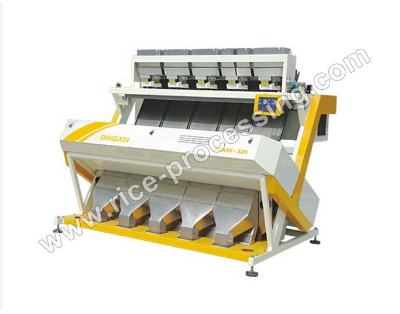
Running a rice mill successfully requires you to ensure uniformity or homogeneity in the final product so that it is easily marketable and acceptable among consumers. This means all the grains that are finally obtained after the milling process must be of the same desired colour and quality. This is the reason why it’s so important to use a rice colour sorter machine that employs optical sensors to detect and eliminate grains that are of a different colour or defective. Variations in grain shade might arise due to the presence of bits of black rice, stone, or partially husked rice. A colour sorter machine can fix this issue through automation and minimise labour costs while improving overall efficiency.
So, let’s understand how a rice colour sorter machine works and the roles played by its different components.
Table of Contents
How a Rice Colour Sorter Machine Works: Explained
Here is a step-by-step look at how a standard rice colour sorter machine functions.
- Input and Distribution of Grains
First, you need to pour the rice grains into the hopper section of the colour sorter machine. Next, you have to distribute them evenly on a chute, conveyor belt, or vibrating feeder, which will carry the grains to the sorting section. The even distribution will ensure that all the grains are laid out in a single layer so that poor-quality ones can be spotted easily.
- Image Capture through Optical Sensors
The most vital part of a rice colour sorter machine, optical sensors boasting high resolution, are placed below or above the rice grain arrangement. They clearly photograph every single grain passing through the area reserved for sorting.
- Lights for Adequate Visibility
You will find the sorting machine equipped with powerful lights like LED to accurately detect the colour of every grain. Lights ensure consistent and complete visibility of all rice grains.
- Analysis of Grain Images
In the central processing unit, the captured images of each grain will be closely analysed in real-time with the help of advanced image processing software. The size, colour, and shape of every rice grain are studied to identify possible variations from what is ideal or any defects.
- Sorting Decision Taken for Every Grain
Post-image analysis, a decision is made for every grain as to whether it meets the quality criteria or not (in case it’s discoloured or defective). Those that pass the analysis with flying colours will continue their journey on the processing line, while those that fail to meet quality standards will be earmarked for ejection.
- Ejection of Subpar Grains
Based on the sorting decision taken for each grain, the machine will get rid of subpar ones by triggering short, high-speed bursts of compressed air. For this, a mechanical or pneumatic ejector will be used. The grains that don’t satisfy quality standards will go into a specific bin.
- Collection of Quality Grains
The final rice stream will only consist of uniform and top-quality grains after the discoloured or defective ones are ejected. These will be collected and packaged suitably for the market.
High-Tech Rice Colour Sorter Machines – Potential Advantages
Rice colour sorter machines designed with the latest technologies might have the following features:
- Interface that is instinctive: Setting parameters for sorting will be easy with a user-friendly interface, and you can even track the process closely.
- Multi-spectral imaging: This form of imaging might be able to identify defects or inconsistencies in a grain that are otherwise invisible to the human eye.
- Self-calibration: Advanced rice colour sorter machines might be able to self-calibrate so that accuracy is guaranteed despite changing conditions and for long durations.
Best Practices for Operating a Rice Colour Sorter Machine
You need to keep the following pointers in mind before using a rice colour sorter machine, so you can make the most of it and ensure safety:
- Gain enough knowledge about the different components and basic functionalities of the machine. Go through the manufacturer’s manual carefully so you do not doubt what every section or part is supposed to do.
- You might have to adjust the colour sorter settings depending on the rice variety you intend to feed the machine. After all, every variety will likely have distinct standards in terms of the shape, size, and whiteness of the grain.
- Decide which grains should be marked as defective by the rice colour sorter machine and set the sorting criteria accordingly. For two different kinds of rice, the criteria might not be the same.
- Check the efficiency settings of the machine, as it can help you keep operational costs low and use less energy.
Conclusion
In a nutshell, the milling process cannot do without a rice colour sorter machine as it helps ensure that you only supply the market with the best quality and consistent grains. Automation will also help you to control the costs of operation, save time, and augment your profit margin. However, with many options available these days, picking the right rice colour sorter machine might seem daunting. So, take time to research about different manufacturers and compare what they have to offer. Also, remember that factors like brand, model, technology, and after-sales support might determine the price of the machine. So, take stock of your mill’s exact needs and consider the budget before taking a call.
